Embracing the Future: David Rockwell on Storytelling and the Power of Place
Long before David Rockwell ever studied architecture, he was already immersed in the art of storytelling. As the youngest of five boys, he spent his childhood watching community theater productions led by his mother, who was deeply involved in the local scene. The performances captivated him, but what lingered most was the transformation of space. The way a plain room could become a gateway to something larger inspired a lifelong fascination with environments that bring people together.

Then, when he was 12, his family moved to Guadalajara, Mexico. The familiar theater on the coast gave way to a city alive with marketplaces, bullrings, and mariachis. “Everything was public space,” Rockwell recalls. “It really expanded my interest in how people gather.”
That contrast between structured performance and spontaneous celebration laid the groundwork for a career built on curiosity, narrative, and a desire to create spaces that feel alive.
Even in his formal education at Syracuse University, Rockwell’s instinct for storytelling remained central. In one urban planning assignment, he was asked to analyze the relationship between buildings and open spaces. He included observations about the people who lived there. “My teacher said that it had nothing to do with the assignment,” Rockwell says, laughing. “I told her, ‘Well, it actually does for me.’”
That instinct has never left him. Today, as founder of Rockwell Group, he leads a studio that treats every project as a story waiting to be told. Whether designing a restaurant or a Broadway set, the goal is the same: to create environments that invite participation and connection.

Casa Cork, an immersive installation unveiled at Milan Design Week, is one of Rockwell’s latest expressions of that philosophy. Conceived as a living laboratory and atelier, the project explores the versatility and sustainability of cork, a material he’s long admired for its tactile warmth and environmental benefits.
Developed by Rockwell Group in collaboration with his nonprofit, the Cork Collective, the installation featured interiors and furnishings made almost entirely of cork. In addition to its show-stopping aura, it served as a space for experimentation and collaboration, pushing the boundaries of what cork can become.
“I’ve always loved cork,” Rockwell says. “You don’t kill a tree to get it—you peel the tree. And harvested cork trees absorb three to five times more CO2 than unharvested ones.”
Through Cork Collective, Rockwell is helping recycle the 13 billion corks discarded annually, transforming them into playground surfaces, furniture, and acoustical solutions. “We’re turning a static material into many different things,” he says. “It’s a great example of how design can be both expressive and responsible.”
In an age shaped by digital tools and algorithmic content, Rockwell’s approach remains grounded in human experience. His studio doesn’t shy away from technology; in fact, Rockwell Group’s LAB actively experiments with software and applications that enhance real-time connection. They’ve even begun training AI models on their own archives to uncover patterns and themes across four decades of work.

Still, Rockwell sees technology as a means, not an end. “It’s just a tool,” he says. “It has to be used not for its own effect, but to help tell one of these stories we’re telling.”
What matters most is the human experience. “We’re always thinking about rituals,” he says. “What makes a space feel hospitable? What allows people to connect in real time?”
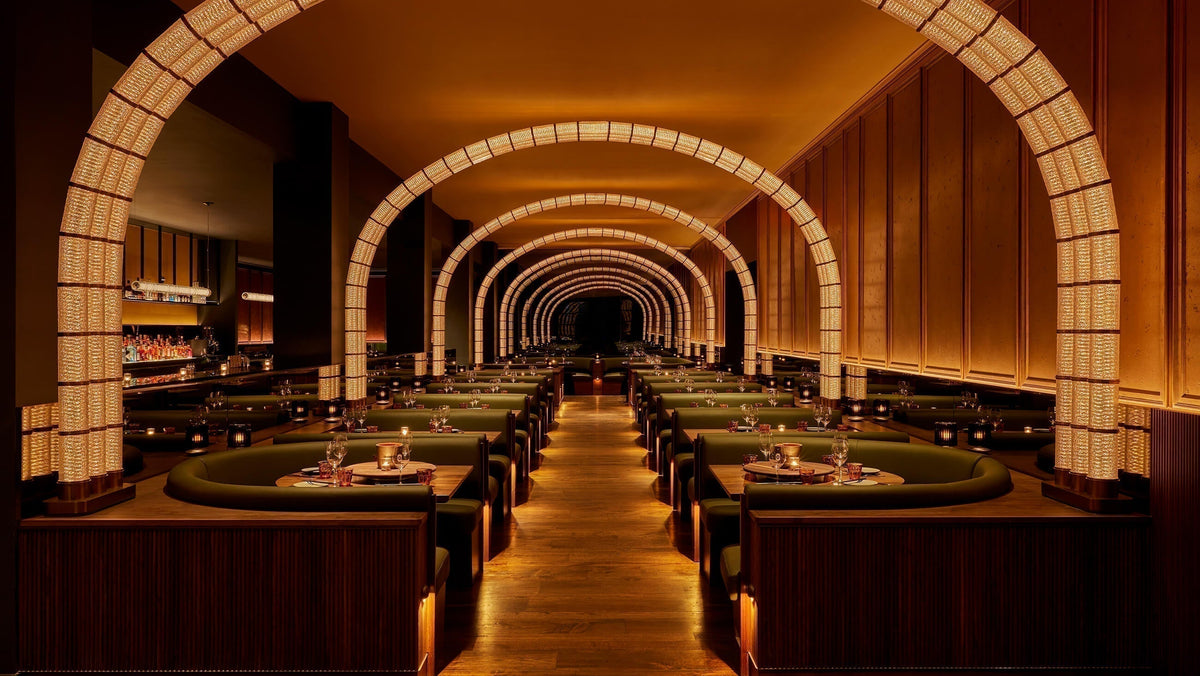
That focus on human rituals and connection informs projects like COQODAQ, an upscale Korean fried chicken restaurant designed in collaboration with Simon Kim. Inspired by post-pandemic conversations about safety and hospitality, the space includes a row of elegant soapstone sinks near the entrance. For guests waiting to be seated, the sinks offer a moment of cleansing, making room for a small but meaningful ritual that sets the tone for the dining experience.
Rockwell’s studio thrives on curiosity. “If you asked me the number-one quality we look for in collaborators—whether it’s a designer, a chef, or a client—it’s curiosity,” he says. “We’re not interested in repeating ourselves. We want to create something new together that everyone feels invested in.”
That mindset has led to a portfolio that spans airport terminals, hotels, theaters, academic buildings, and more. By refusing to be defined by typology, Rockwell Group has created space for ideas to move freely across disciplines. Lessons from hospitality inform academic spaces; theatrical design principles shape transportation hubs. “Not being known for one thing is freeing,” Rockwell says. “It lets us bring knowledge from one domain into another.”
Current projects include a museum in Mexico City dedicated to Frida Kahlo’s personal life, a theater-inspired steakhouse in Las Vegas, and a revival of the musical Chess. Each one begins with a story, unfolds through collaboration, and aims to spark wonder.
And there are still dreams on the horizon. “I’ve always wanted to create an opera house,” Rockwell says with a smile. “And a big park, something choreographed like Central Park. Hopefully someone who reads this sees that.”
So how does Rockwell stay inspired after decades of prolific work? He plays piano daily. He walks through cities and gets lost. He explores his studio, looking for new materials, new ideas, and new stories waiting to be told. And of course, he visits the theater.
Each of these are his own rituals that play a part in a larger pursuit. Whether he’s working with cork, designing a restaurant, or reimagining a museum, Rockwell returns to the same question: How can design invite people to participate more fully in the world around them?
It’s a question that guides his studio’s work, and it continues to guide him. The materials may change. The collaborators may shift. But the pursuit stays the same: to create something meaningful, something new, something that tells a story worth gathering around.


Some things are too good to keep to yourself.