Learning in Space Valley
Article originally published on Haworth Spark
At The University of Texas at El Paso (UTEP), the new Advanced Manufacturing and Aerospace Center (AMAC) building redefines how design can drive innovation and collaboration.
The project was born out of necessity. UTEP’s College of Engineering was growing rapidly, and two of its leading research centers—the W.M. Keck Center for 3D innovation and the Aerospace Center—needed dedicated, co-located facilities. Previously scattered across and off campus, their separation hindered collaboration and efficiency.
“We were spread out in small groups,” says Dr. Shery Welsh, Executive Director of the Aerospace Center. “It made it harder for us to work together.”
Designing for Innovation
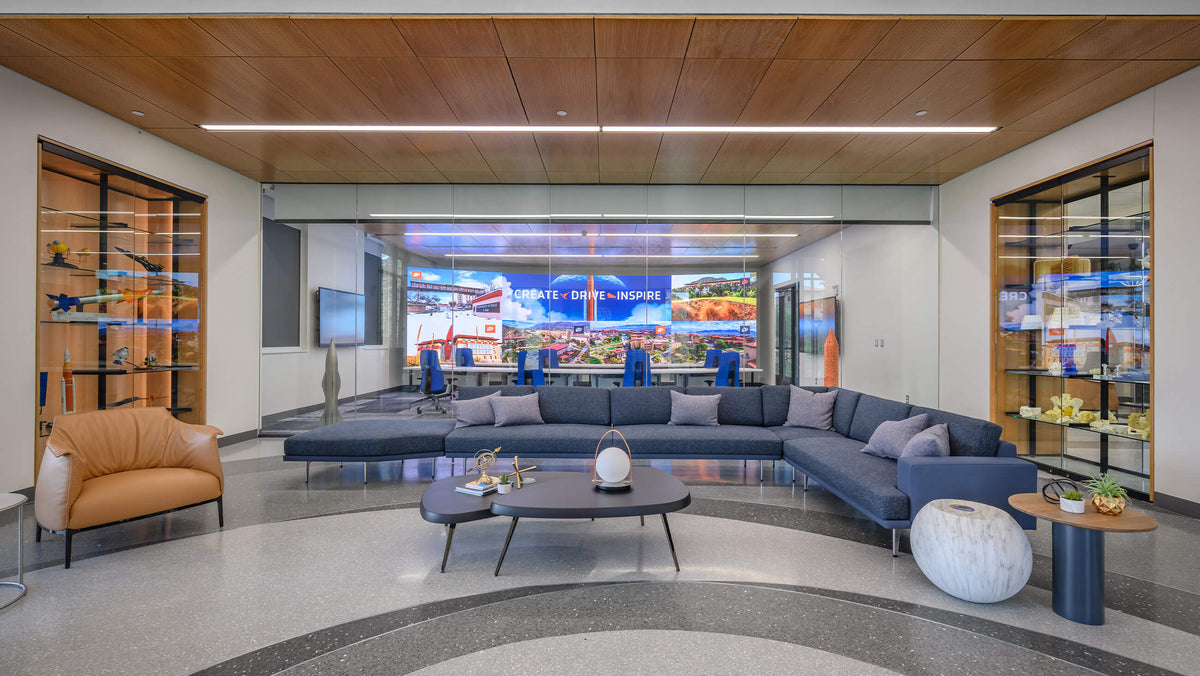
The solution: a state-of-the-art building designed to unite the centers under one roof while preserving their unique identities. Interior Design Supervisor Erin B. Rivera envisioned a space that reflected the cutting-edge work taking place. “We wanted to evoke high technology and sophistication,” she says. “We moved away from traditional palettes and created a modern, streamlined aesthetic.”

One Building, One Mission
The impact was immediate. Even before the official opening, faculty and students began exploring each other’s labs. “People were welcoming each other into their spaces,” Welsh says. “That led to real collaboration. We feel so much closer now.”
Dr. Luz Bugarin, Director of Operations for the Aerospace Center, echoes that sentiment. “We’ve adopted a new model of ‘one building, two centers,’ and we’re all working toward one mission.”
One of the building’s standout features is the Mission OPS center—a dramatic space with a wall-to-wall digital display visible through glass paneling. “It’s like being transported to a NASA facility,” Rivera says. “You walk in and immediately feel like something special is happening.”
Design details throughout the building reinforce this sense of purpose. Blue tile accents aid wayfinding, and display cases showcase student-made components. Every element is intentional.
A Hub for Outreach
The building has also become a powerful outreach tool. Since opening, it has hosted numerous tours for government agencies, industry partners, and national labs. “People get energized when they visit,” Welsh says. “They see the space and immediately start talking about research collaborations or partnerships.”

For Welsh and Bugarin, the outcomes matter as much as the aesthetics. They’re tracking metrics like student employment, graduation rates, lab utilization, and partnerships. They’re also expanding regional research efforts, working with city officials and other universities in what they call “Space Valley.”
A Catalyst for Innovation

That broader vision is reflected in the AMAC building itself. It’s a testament to how a thoughtfully designed space can shape culture, encourage innovation, and foster collaboration. Its advanced infrastructure and multidisciplinary layout make it a hub for innovation in manufacturing. It’s a place where students gain hands on experience that prepares them for a fast-changing industry, faculty find the resources to pursue bold ideas, and visitors feel the pulse of possibility.


Some things are too good to keep to yourself.