Embracing the (Primitive) Future: Architecture That Refuses the Spotlight with Chad Oppenheim
Originally published in Great Spaces Issue 3
Chad Oppenheim talks about the future in ancient terms: wind and stone, sunlight and silence, and the instinctive ways we respond to shelter and landscape. This outlook shaped his architectural practice, a firm whose work spans continents and shapes experiences that connect us to the natural world.

As a kid, Chad Oppenheim drew cars constantly. Inspired by the hero vehicles he saw in movies and on TV, he drew so much that he had to trade his sketches for more pencils on the playground. Ask a young Oppenheim what he wanted to be when he grew up, and the answer was easy: a car designer.
His turn toward architecture came at a kitchen table in suburban New Jersey. When he was eight, his father decided to buy a lot and build a house. Oppenheim remembers the family sitting with an architect, talking through ideas, and inventing their dream home in conversation.
The dialogue hooked him. He would not pursue the cars he had been sketching obsessively, at least not as a career. He would pursue the feeling that design could conjure when it took the shape of a place.
That instinct widened as he grew older. As a teenager watching Miami Vice with his father, he fell for the aura of Miami, a city that seemed to blur imagination and reality in ways that echoed his earliest experiences with design. The pull stayed with him through stints in Europe and Asia, eventually drawing him to Florida. There, he worked hundred-hour weeks, sharpening his skills until he was ready to chart his own course. He passed his licensure exams, and started taking on projects of his own.
Those projects became the seed of something larger, and in 1999, he opened his own firm. Since then, Oppenheim Architecture has expanded globally, opening studios in Basel, Switzerland, and Tirana, Albania— cities with centuries of rich design heritage.
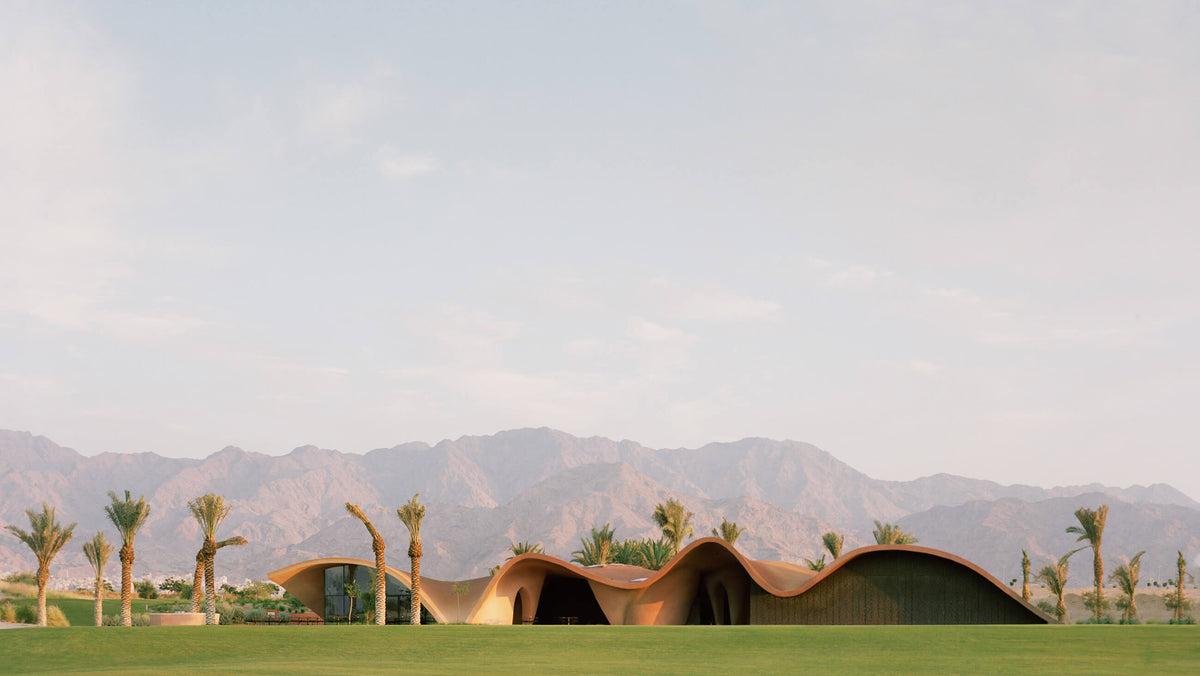
Look at enough of Oppenheim Architecture’s projects, and a pattern emerges. The buildings blend with the landscape, sometimes to the point of near disappearance. The Ayla Golf Clubhouse in Aqaba, Jordan, shows how fully this philosophy can take shape, rising out of the dunes as if the desert itself decided to build.
“Most of the time, people want the building to be the focal point, so all kinds of work goes into elaborate, highly prominent design,” Oppenheim says. “But for me, I don’t want to see the building. I want to celebrate the beauty of the site. And when you look at it that way, the building can be more hidden, or at least a little shy.”
But “shy” is an unfashionable word in a profession that rewards visibility. An architect who wants buildings to disappear faces a professional dilemma. Visibility drives reputation, and reputation drives commissions. For Oppenheim, however, the goal isn’t concealment for its own sake. Instead, he challenges us to reorient our expectations; to see the building as an instrument that heightens our perception of the land rather than something that competes with it.
Back in 2018, after days of driving and hours hiking through Saudi Arabian desert landscape, Oppenheim was given the perfect opportunity to put this ideology to the test.
He’d been given no map. Instead, the location chose him. In the midst of the intense heat, a massive rock formation offered relief in the form of shade and crevices. It was this natural respite that solidified his choice. “That’s the project,” he told the group. “It’s right there. We just have to uncover it.”
Oppenheim’s firm wasn’t the first one selected for the project. Initially, others brought forward concepts that felt too familiar and expected, even if they were competent. Their designs could have been lifted from anywhere, placed on any landscape. But the client wanted something that could exist only in Saudi Arabia.

Oppenheim explains that the team ultimately chose the site because it demanded more than the traditional architectural playbook. The client asked for something inseparable from its surroundings, and Oppenheim’s firm offered a different kind of spectacle, one where the land stayed legible because the architecture stopped shouting.
And thus, Desert Rock, an ultra-luxury resort carved directly into the landscape, was born.
Pursuing this kind of distinctiveness rarely happens easily. People want novelty in theory, but default to familiarity in practice. Ultimately, they end up buying certainty, and certainty usually means familiar typologies and proven standards. Many of Oppenheim’s projects depend on clients who recognize that true distinctiveness does not come from novelty for its own sake. It comes from allowing the place itself to set the identity and from accepting the productive discomfort that comes with stepping outside the familiar.

Architecture has been, for centuries, a practice of power. As Oppenheim says, “If you think about civilization, architecture has always been about imposing our dominance on the natural environment.” The work of Oppenheim Architecture tries to reverse that narrative with a different set of priorities: symbiosis, harmony, and, most tellingly, partnership.
“I think that a lot of architects really focus on creating something on the land so that it stands out as a tribute to what people can do,” he says. “But we want to work with the land, because it lets us overlay this incredible sensitivity to experience. We can be less dependent on buildings, and more in tune with the natural world. And we believe this helps people really feel the place more.”
Working this way requires the patience of a naturalist paired with the precision of a surveyor, so that every contour and crevice is included in the design before any architectural lines are drawn.
Oppenheim calls this working toward a primitive future, where cutting-edge technology is used to deliver elemental results. It was this mindset that guided the development of Desert Rock. High-resolution scans mapped the stone outcrops so rooms can slip into shadows. Solar studies and careful orientation temper heat before any man-made system is switched on. The landscape itself is the source of the experience, shaping how visitors understand the place around them.
If Desert Rock offers a lesson, it is that the best designs change what we notice by refusing to compete for attention. The resort is a careful edit of what was there all along: a way of inhabiting the desert without rewriting it, a hospitality experience that stems from restraint.
That discipline clarifies what Oppenheim means when he says that, for him, success is when you go somewhere and “you don’t see architecture, but you understand the place in a deeper way.” Desert Rock encourages visitors to notice how their own attention changes when the environment is allowed to lead.
This is Oppenheim’s primitive future, where architecture sharpens our awareness of the land. Here, the land regains its voice and returns our capacity to feel.
Oppenheim in Print
Chad Oppenheim designs buildings that step back so the site can take center stage. His books extend that impulse, tracing how place and design shape what we feel.
Spirit of Place Spirit of Place explores seven of Oppenheim Architecture’s acclaimed projects located in beautiful settings across the globe. With 120 photographs and minimal text, it foregrounds the firm’s “form follows feeling” approach.
Lair: Radical Homes and Hideouts of Movie Villains Why do bad guys live in such great houses? Lair examines the nefarious homes featured in 15 films. Using photography, architectural renderings, essays, film analyses, and interviews with directors and production designers, Lair treats film sets as narrative architecture.
Ride: The Most Iconic Wheels of the Silver Screen Ride shifts the lens from rooms to roads, profiling 34 movie cars and motorcycles that function as film characters. Packed with images and insider context, it explores how vehicles were chosen and mythologized. Foreword by Jay Leno.


Some things are too good to keep to yourself.